In this article, you will find information on obsessive compulsive disorder (OCD) including its definition, symptoms, causes, treatment and coping strategies.
Introduction
Obsessive compulsive disorder (OCD) is a very widespread mental disorder that affects thousands of people throughout the world. However, although people tend to use the term OCD for describing someone’s obsession with cleanliness or organization, it is a serious condition which can have a huge impact on one’s daily activities, personal and professional relationships, etc.
From my experience as a healthcare provider, I would like to say that obsessive-compulsive disorder can be very stressful for patients and their families. Luckily, it is a condition which can be treated properly if an adequate diagnosis and necessary treatment are received.
Learn about Obsessive-Compulsive Disorder (OCD), including its symptoms, causes, risk factors, diagnosis, and treatment options. Discover how therapy, medications, and lifestyle strategies can help manage OCD and improve quality of life.
What Is Obsessive-Compulsive Disorder (OCD)?
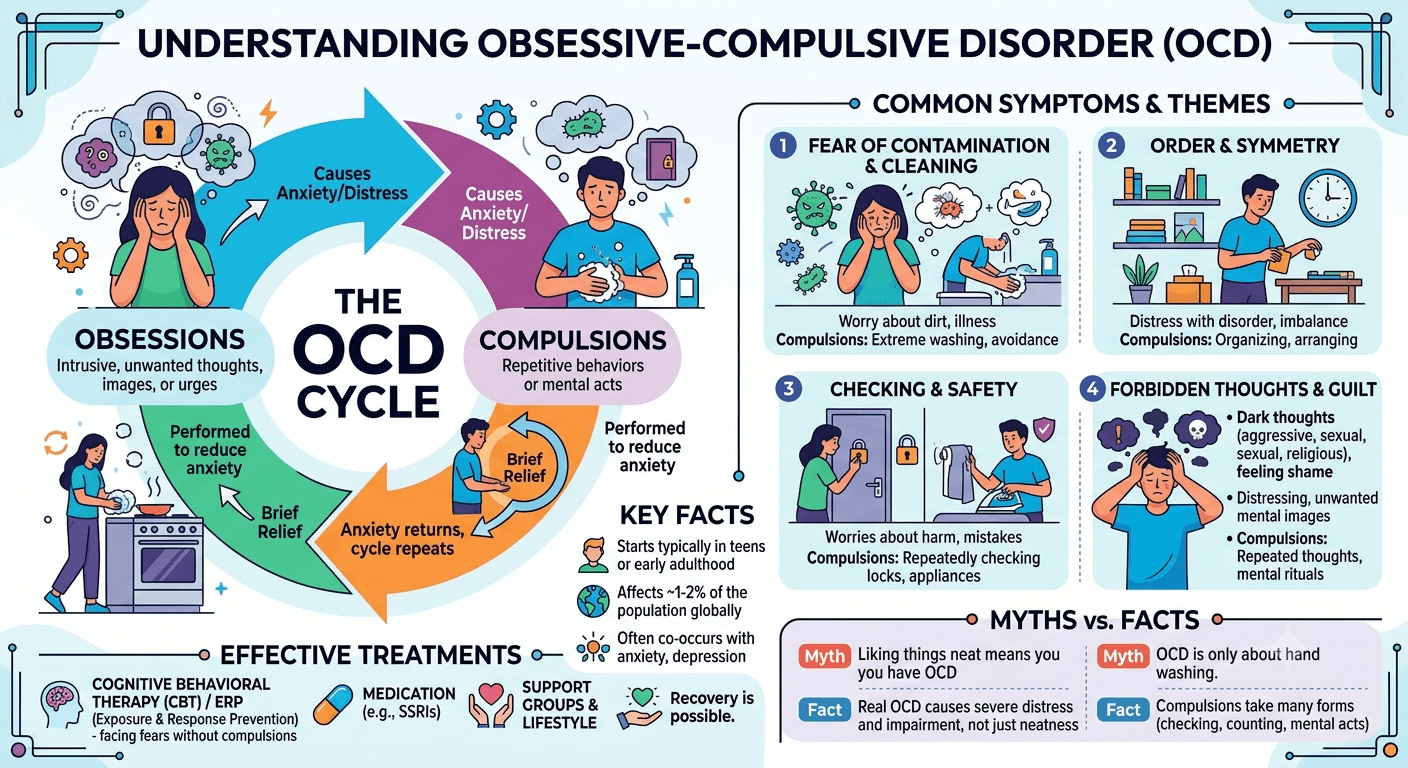
Obsessive compulsive disorder (OCD) is a chronic mental condition characterized by:
- Obsessions – persistent and intrusive thoughts, urges, images which cause anxiety and distress;
- Compulsions – repetitive activities and behaviors which people engage in order to alleviate the anxiety or avoid negative consequences.
Patients with OCD usually realize that their obsessions and compulsions are irrational but they cannot control them.
Here are examples of obsessions and compulsions:
- A patient is constantly thinking about the possibility of having contaminated his/her hands (obsession).
- The person washes his/her hands dozens of times per day in order to relieve anxiety (compulsion).
The cycle of obsession and compulsion can consume hours each day and significantly impair functioning.
Types of OCD
OCD is unique for each patient; however, there are some typical symptoms of the disease.
1. Contamination OCD
Fear of germs, dirt, chemicals, bodily fluids, illness.
Typical compulsions:
- Frequent hand washing
- Frequent showers
- Multiple cleanings of household items
- Refusal to go to public places
Example
An individual washes his or her hands for 30 minutes after using a door handle because of the fear of infection.
2. Checking OCD
An obsession with the idea that something terrible can happen because of one’s negligence.
- Typical compulsions:
- Re-checking locks
- Re-checking appliances
- Checking the email repeatedly
- Confirmation of the performed security measures
Example
An individual goes back home several times a day to make sure that the stove is switched off.
3. Symmetry and Ordering OCD
The need to keep objects in an exact order or to reach symmetry.
Typical behaviors:
- Keeping things symmetrical
- Doing actions until they become “just right”
- Counting rituals
Example
An individual may spend hours on aligning books correctly.
4. Intrusive Thoughts OCD
This type is characterized by distressing unwanted thoughts connected with:
- Violence
- Sexuality
- Religious issues
- Self-harm or harm to other people
It should be noted that these thoughts do not correspond to the real intentions and desires of the individual.
Example
An individual experiences intrusive thoughts about harming his or her kid and feels guilty about that without any intention to do it.
5. Hoarding-related OCD
Despite the fact that the hoarding disorder is considered as a different disease, there are still individuals who suffer from OCD that have trouble with discarding items because of their obsessive fears.
Typical fears:
- Fear of not having the item when you need it
- Fear of making mistakes
- Emotional attachment to object
Pathophysiology of OCD
Understanding the biological basis of OCD helps reduce stigma and highlights that OCD is a genuine medical condition rather than a personal weakness.
Brain Circuit Abnormalities
Research suggests that OCD involves dysfunction in specific brain circuits, particularly the:
- Orbitofrontal cortex
- Anterior cingulate cortex
- Basal ganglia
- Thalamus
These regions are involved in:
- Decision-making
- Error detection
- Emotional regulation
- Habit formation
When these circuits become overactive, the brain may repeatedly signal that something is wrong, even when no actual danger exists.
Neurotransmitter Imbalances
Neurotransmitters are chemical messengers that help brain cells communicate.
Several neurotransmitters have been implicated in OCD:
Serotonin
Serotonin dysregulation is strongly linked to OCD and forms the basis for many effective medications.
Dopamine
Abnormal dopamine activity may contribute to repetitive behaviors and compulsions.
Glutamate
Emerging research suggests glutamate dysfunction may play a role in OCD symptoms.
Genetic Factors
Family studies indicate a significant hereditary component.
People are at increased risk if:
- A parent has OCD
- A sibling has OCD
- Multiple family members have anxiety disorders
However, genetics alone do not determine whether someone develops OCD.
Symptoms of OCD
Symptoms vary widely but generally involve obsessions, compulsions, or both.
Common Obsessions
- Fear of contamination
- Fear of harming others
- Excessive doubt
- Need for certainty
- Intrusive violent thoughts
- Religious or moral concerns
- Fear of making mistakes
Common Compulsions
- Hand washing
- Cleaning
- Checking
- Counting
- Repeating words or actions
- Seeking reassurance
- Arranging objects
- Mental rituals
Emotional Symptoms
Many individuals experience:
- Anxiety
- Shame
- Guilt
- Depression
- Frustration
- Social withdrawal
Physical Consequences
Severe OCD may lead to:
- Skin damage from excessive washing
- Sleep disturbances
- Fatigue
- Poor concentration
- Reduced productivity
Causes and Risk Factors
The exact cause of OCD remains unknown, but several factors contribute to its development.
Genetics
Research consistently shows a hereditary component.
Risk increases when close relatives have OCD or anxiety disorders.
Brain Structure and Function
Differences in brain activity and communication pathways appear to contribute to OCD development.
Environmental Factors
Potential triggers include:
- Childhood trauma
- Abuse
- Stressful life events
- Major transitions
- Chronic stress
Infections
In rare cases, children may develop OCD symptoms suddenly following streptococcal infections.
This condition is known as:
- Pediatric Autoimmune Neuropsychiatric Disorders Associated with Streptococcal Infections (PANDAS)
Research in this area remains ongoing.
Personality Traits
Certain characteristics may increase vulnerability:
- Perfectionism
- High responsibility
- Need for control
- Intolerance of uncertainty
These traits alone do not cause OCD but may contribute to symptom development.
Diagnosis of OCD
Early diagnosis is essential because untreated OCD often worsens over time.
Clinical Evaluation
Diagnosis is based primarily on:
- Detailed medical history
- Psychiatric assessment
- Symptom evaluation
- Functional impairment assessment
Mental health professionals assess:
- Presence of obsessions
- Presence of compulsions
- Duration of symptoms
- Impact on daily life
Diagnostic Criteria
According to modern psychiatric guidelines, OCD is diagnosed when:
- Obsessions or compulsions are present
- Symptoms are time-consuming
- Symptoms cause distress
- Symptoms interfere with functioning
- Symptoms are not better explained by another condition
Screening Tools
Healthcare professionals may use:
- Yale-Brown Obsessive Compulsive Scale (Y-BOCS)
- Obsessive-Compulsive Inventory (OCI)
These tools help determine symptom severity.
Treatment Options for OCD
OCD treatment typically involves a combination of psychotherapy, medication, education, and lifestyle modifications.
Early intervention often leads to better outcomes.
Therapy for OCD
Cognitive Behavioral Therapy (CBT)
CBT is considered one of the most effective treatments for OCD.
The therapy helps individuals:
- Identify irrational beliefs
- Challenge distorted thinking
- Develop healthier coping strategies
- Reduce compulsive behaviors
Benefits of CBT
- Long-lasting symptom improvement
- Better emotional regulation
- Increased confidence in managing symptoms
Exposure and Response Prevention (ERP)
ERP is a specialized form of CBT and is considered the gold standard treatment for OCD.
How ERP Works
Patients are gradually exposed to situations that trigger anxiety while refraining from performing compulsions.
Example
A person with contamination OCD may touch a public surface and resist washing their hands immediately.
Over time:
- Anxiety decreases naturally
- Fear loses its power
- Compulsive behaviors diminish
Acceptance and Commitment Therapy (ACT)
ACT teaches individuals to:
- Accept intrusive thoughts
- Reduce struggles against anxiety
- Focus on personal values
- Increase psychological flexibility
ACT may complement CBT and ERP.
Medications for OCD
Medication is often recommended for moderate to severe OCD.
Selective Serotonin Reuptake Inhibitors (SSRIs)
SSRIs are the first-line medications.
Common examples include:
- Fluoxetine
- Sertraline
- Fluvoxamine
- Paroxetine
- Escitalopram
These medications increase serotonin activity in the brain and often reduce obsessive thoughts and compulsive behaviors.
Clomipramine
Clomipramine is another effective medication specifically approved for OCD treatment in many regions.
It may be considered when SSRIs are ineffective.
Treatment Considerations
Patients should understand that:
- Improvement may take 8–12 weeks or longer
- Medication works best when combined with therapy
- Regular follow-up is important
- Medication should not be stopped abruptly
Living With OCD
Living with OCD can be challenging, but many individuals lead fulfilling, productive lives with proper treatment and support.
Build a Support System
Support from:
- Family
- Friends
- Therapists
- Support groups
can significantly improve recovery.
Learn About OCD
Education reduces fear and helps individuals understand that intrusive thoughts are symptoms not reflections of character.
Practice Stress Management
Helpful techniques include:
- Mindfulness
- Meditation
- Deep breathing
- Yoga
- Regular exercise
Stress often worsens OCD symptoms, making self-care particularly important.
Frequently Asked Questions (FAQs)
Is OCD just about cleanliness?
No. While contamination fears are common, OCD can involve checking, intrusive thoughts, symmetry concerns, and many other symptoms.
Can OCD go away on its own?
Some symptoms may fluctuate, but OCD often requires professional treatment for significant improvement.
Are intrusive thoughts dangerous?
No. Intrusive thoughts are unwanted mental events and do not indicate that a person will act on them.
Can children develop OCD?
Yes. OCD frequently begins during childhood, adolescence, or early adulthood.
Is OCD hereditary?
Genetics play an important role, but environmental factors and brain function also contribute.
What is the most effective treatment for OCD?
Exposure and Response Prevention (ERP), a specialized form of CBT, is considered the most effective psychotherapy for OCD and is often combined with medication when necessary.
Can people with OCD live normal lives?
Absolutely. With appropriate treatment and support, many individuals successfully manage symptoms and enjoy fulfilling personal and professional lives.
Conclusion
Obsessive Compulsive Disorder (OCD) is a difficult yet treatable mental disorder which manifests itself in the form of obsessive thoughts and repetitive behaviors that might disrupt an individual’s day-to-day routine. Current medical research suggests that OCD is associated with physiological, psychological, and environmental triggers, involving the changes in brain circuitry, neurotransmission, genetics, and life experiences.
Identifying the symptoms early on and consulting professionals are essential steps towards healing. Evidence-based practices such as cognitive behavioral therapy, exposure and response prevention, and medications have allowed many to get their lives back in order.
Above all else, patients suffering from OCD need to realize that they are not their symptoms. Recovery is definitely possible with the right approach.
Disclaimer: The information provided in this blog post is for educational and informational purposes only and should not be considered medical advice. It is not intended to replace professional medical consultation, diagnosis, or treatment. Always seek the guidance of a qualified healthcare professional regarding any medical condition or health-related concerns.