
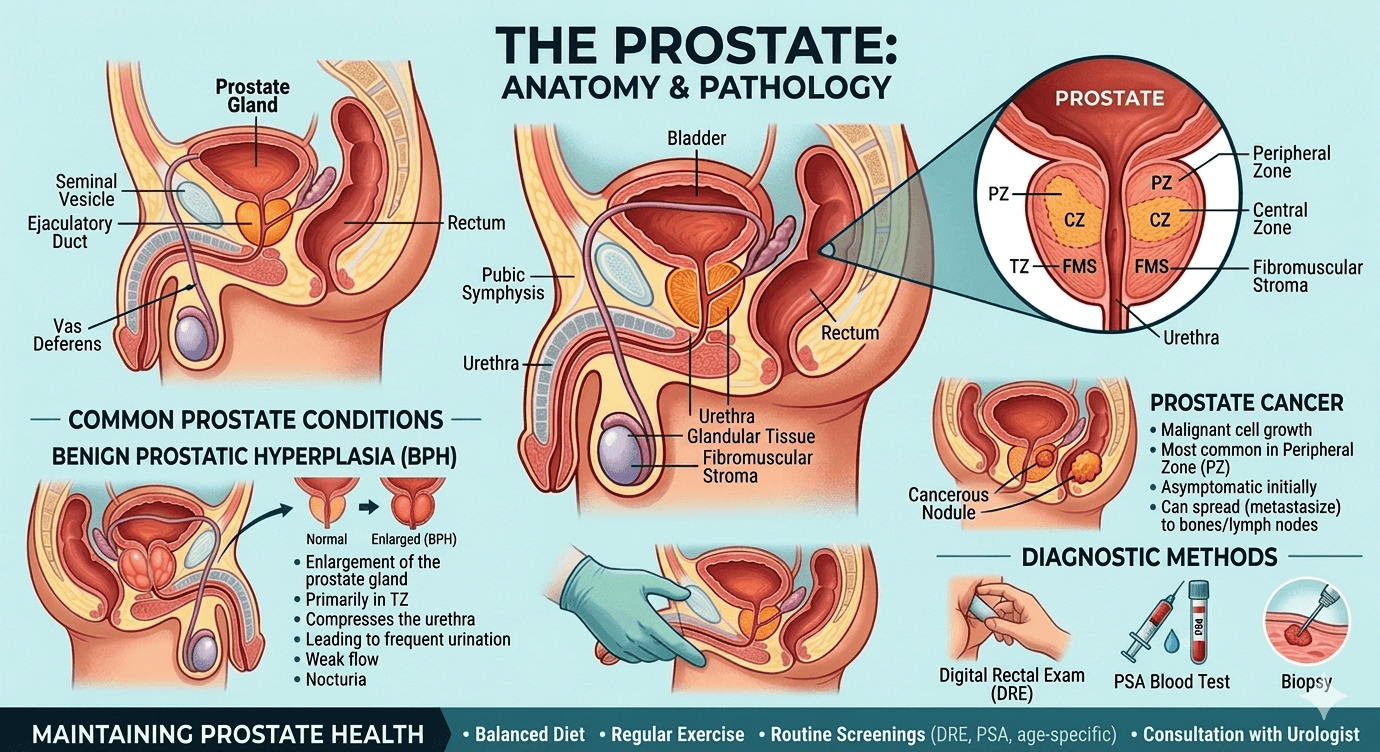
And Effective Treatments That Can Improve Your Life
Introduction
Benign Prostatic Hyperplasia (BPH), commonly referred to as an enlarged prostate, is among the most frequent urinary disorders seen in older men. The condition occurs when the prostate gland gradually increases in size and compresses the urethra, leading to lower urinary tract symptoms (LUTS). Although BPH is a non-cancerous condition, it can greatly reduce quality of life and may result in serious complications if not properly managed.
Learn everything about Benign Prostatic Hyperplasia (BPH), including causes, symptoms, diagnosis, treatment options, lifestyle changes, and prevention tips in this complete guide for patients and caregivers.
BPH becomes increasingly common after the age of 50. Its progression is usually slow, with symptoms ranging from mild urinary discomfort to severe urinary obstruction. A solid understanding of prostate anatomy, disease mechanisms, clinical features, diagnosis, treatment options, and possible complications is valuable for both patients and medical students.
Anatomy and Role of the Prostate
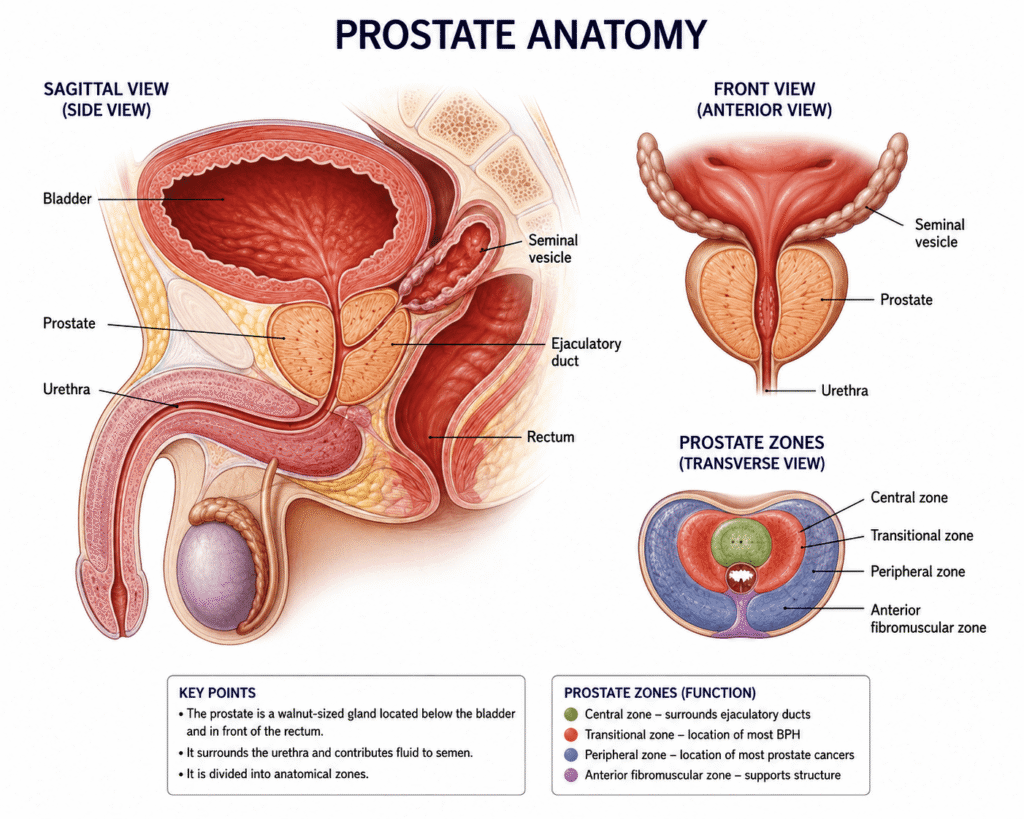
The prostate is a small gland situated beneath the bladder and anterior to the rectum. It surrounds the first segment of the urethra, called the prostatic urethra.
That’s correct. In healthy young men, the prostate gland typically weighs around 20 grams. Its main role is to produce prostatic secretions that form part of semen and help support sperm survival.
Prostate Zones
The prostate contains several anatomical regions:
- Peripheral Zone: Most prostate cancers develop here.
- Transitional Zone: The primary site where BPH occurs.
- Central Zone: Encircles the ejaculatory ducts.
- Anterior Fibromuscular Stroma: Mainly composed of muscle tissue.
With aging, both stromal and epithelial cells in the transitional zone undergo hyperplasia, causing prostate enlargement.
What Is BPH?
https://www.youtube.com/watch?v=WfOTIf8QEm0
Benign Prostatic Hyperplasia refers to the non-malignant increase in the number of smooth muscle and epithelial cells within the prostate gland. This enlargement may partially obstruct urinary flow.
The term includes:
- Benign: Non-cancerous
- Hyperplasia: Increase in cell quantity
Although BPH is different from prostate cancer, both diseases can exist together in elderly men.
Epidemiology
BPH is closely linked to advancing age.
Age Distribution
- Rare before 40 years of age
- Frequently develops after age 50
- Seen in nearly half of men by age 60
- Histological evidence is present in 80–90% of men by age 80
Not every man with prostate enlargement develops symptoms.
Risk Factors
Several factors contribute to the development of BPH:
1. Aging
The most significant contributing factor.
2. Hormonal Influences
Testosterone is converted into dihydrotestosterone (DHT) by the enzyme 5-alpha reductase. DHT promotes prostate growth.
3. Family History
Men with affected family members may experience earlier onset.
4. Obesity and Metabolic Syndrome
Conditions such as diabetes, hypertension, obesity, and abnormal lipid levels are associated with higher risk.
5. Lack of Physical Activity
Sedentary habits may worsen disease progression.
6. Cardiovascular Disease
Impaired vascular health may contribute to prostate enlargement.
Pathophysiology
BPH develops through both mechanical and functional mechanisms.
Static Component
An enlarged prostate physically compresses the urethra, increasing resistance to urinary flow.
Dynamic Component
Increased smooth muscle tone mediated by alpha-adrenergic receptors further narrows the urethra.
Bladder Adaptations
Initially, the bladder compensates by increasing muscular contractions. Over time, chronic obstruction may lead to:
- Bladder wall thickening
- Reduced compliance
- Urinary retention
- Detrusor dysfunction
Clinical Symptoms of BPH
The symptoms are collectively known as Lower Urinary Tract Symptoms (LUTS) and are categorized as obstructive or irritative.
Obstructive Symptoms
- Weak urinary stream
- Difficulty initiating urination
- Intermittent urine flow
- Straining during urination
- Feeling of incomplete bladder emptying
- Post-void dribbling
- Urinary retention
Irritative Symptoms
- Increased urinary frequency
- Urgency
- Nocturia
- Urge incontinence
International Prostate Symptom Score (IPSS)
The IPSS is commonly used to evaluate symptom severity.
Severity Levels
- Mild: 0–7
- Moderate: 8–19
- Severe: 20–35
This scoring system helps determine appropriate management.
Complications of Untreated BPH
If left untreated, BPH can result in significant complications:
- Acute urinary retention
- Chronic urinary retention
- Recurrent urinary tract infections
- Bladder stone formation
- Hematuria
- Hydronephrosis
- Renal impairment or failure
Diagnosis
Diagnosis combines history-taking, physical examination, laboratory testing, and imaging.
Clinical History
Important information includes:
- Severity and duration of symptoms
- Frequency of Nocturia
- Episodes of urinary retention
- Presence of hematuria
- Medication use
- Neurological symptoms
Physical Examination
General Examination
Assessment of hydration, neurological status, and bladder distension.
Abdominal Examination
A palpable bladder may indicate retention.
Digital Rectal Examination (DRE)
Typical BPH findings include:
- Enlarged gland
- Smooth surface
- Firm consistency
- Non-tender prostate
Hard nodules may raise suspicion for prostate cancer.
Laboratory and Imaging Studies
Urinalysis
CBC,
Lipid Profile
RBS, HbA1c
Serum Creatinine
Assesses kidney function Test (KFT)
Prostate-Specific Antigen (PSA)
PSA levels may rise in:
- BPH
- Prostatitis
- Prostate cancer
Imaging and Additional Tests
- Ultrasound for prostate size and residual urine
- Post-void residual volume measurement
- Uroflowmetry to assess urinary flow
- Cystoscopy in selected patients
Differential Diagnosis
Conditions resembling BPH include:
- Prostate cancer
- Urinary tract infection
- Bladder cancer
- Urethral stricture
- Neurogenic bladder
- Overactive bladder
- Chronic prostatitis
Management of BPH
Conservative Measures
Mild symptoms may improve with lifestyle adjustments.
Lifestyle Recommendations
- Reduce evening fluid intake
- Limit caffeine and alcohol
- Practice scheduled voiding
- Avoid decongestants
- Maintain healthy weight and exercise regularly
Medical Therapy
Alpha-1 Adrenergic Blockers
Examples:
- Tamsulosin
- Alfuzosin
- Silodosin
- Doxazosin
These medications relax smooth muscle in the prostate and bladder neck, improving urinary flow.
Common Side Effects
- Dizziness
- Orthostatic hypotension
- Retrograde ejaculation
5-Alpha Reductase Inhibitors
Examples:
- Finasteride
- Dutasteride
These drugs reduce DHT production and gradually shrink prostate size.
Benefits
- Lower risk of retention
- Reduced need for surgery
Side Effects
- Reduced libido
- Erectile dysfunction
- Lower ejaculate volume
Most effective in men with larger prostates.
Combination Therapy
Alpha blockers and 5-alpha reductase inhibitors may be combined for moderate to severe symptoms.
Phosphodiesterase-5 Inhibitors
Tadalafil may help men with both BPH and erectile dysfunction.
Surgical Treatment
Surgery is considered when:
- Medications fail
- Recurrent urinary retention occurs
- Kidney function declines
- Recurrent infections develop
- Bladder stones are present
Common Procedures
Transurethral Resection of the Prostate (TURP)
Considered the traditional gold-standard surgery.
Advantages
- Excellent symptom relief
- Improved urinary flow
Possible Complications
- Bleeding
- Infection
- Retrograde ejaculation
- Urethral stricture
- TUR syndrome
Laser Procedures
Examples:
- HoLEP
- GreenLight laser therapy
Benefits include less bleeding and shorter hospitalization.
Open or Simple Prostatectomy
Reserved for extremely enlarged prostates.
Minimally Invasive Therapies
Examples:
- UroLift
- Rezūm therapy
- Prostatic artery embolization
These may better preserve sexual function in selected patients.
Acute Urinary Retention
This is a medical emergency.
Symptoms
- Severe lower abdominal pain
- Inability to urinate
- Distended bladder
Treatment
- Immediate catheterization
- Alpha blocker therapy
- Further evaluation for definitive management
BPH Versus Prostate Cancer
| Feature | BPH | Prostate Cancer |
| Nature | Benign | Malignant |
| Main Location | Transitional zone | Peripheral zone |
| DRE Findings | Smooth enlargement | Hard nodules |
| Metastasis | Absent | Possible |
Prevention and Risk Reduction
Although BPH cannot always be prevented, healthy habits may slow progression.
Helpful Measures
- Maintain ideal body weight
- Exercise routinely
- Control diabetes and hypertension
- Eat fruits and vegetables
- Avoid smoking
- Limit alcohol use
Prognosis
The outlook for BPH is generally excellent with appropriate treatment. Many men experience major improvement in urinary symptoms and quality of life through medications or surgery. Delayed care, however, can increase the risk of bladder and kidney complications.
Important Facts
- BPH mainly affects the transitional zone.
- DHT has a central role in disease development.
- Symptoms are divided into obstructive and irritative LUTS.
- DRE and IPSS are important assessment tools.
- PSA is useful but not specific for cancer.
- Alpha blockers provide rapid relief.
- 5-alpha reductase inhibitors shrink prostate tissue.
- TURP remains a major surgical option.
- Acute urinary retention is an emergency.
When to Seek Medical Care
Patients should seek evaluation if they experience:
- Difficulty urinating
- Weak stream
- Blood in urine
- Frequent nighttime urination
- Painful urination
- Sudden inability to urinate
- Recurrent urinary infections
Early treatment helps prevent complications and improves long-term outcomes.
Conclusion
Benign Prostatic Hyperplasia is a very common condition in aging men and a major cause of lower urinary tract symptoms. While non-cancerous, it can substantially affect daily living and may lead to urinary retention, infections, bladder dysfunction, and kidney damage if untreated.
Modern advances in diagnosis and therapy have significantly improved outcomes. Treatment options range from lifestyle modifications and medications to minimally invasive procedures and surgery. A thorough understanding of BPH is important for both patients and medical trainees.
With proper medical management and regular follow-up, most men with BPH can achieve effective symptom control and maintain a high quality of life.
Disclaimer: The information provided in this blog post is for educational and informational purposes only and should not be considered medical advice. It is not intended to replace professional medical consultation, diagnosis, or treatment. Always seek the guidance of a qualified healthcare professional regarding any medical condition or health-related concerns. The author and publisher are not responsible for any actions taken based on the information presented in this article.