
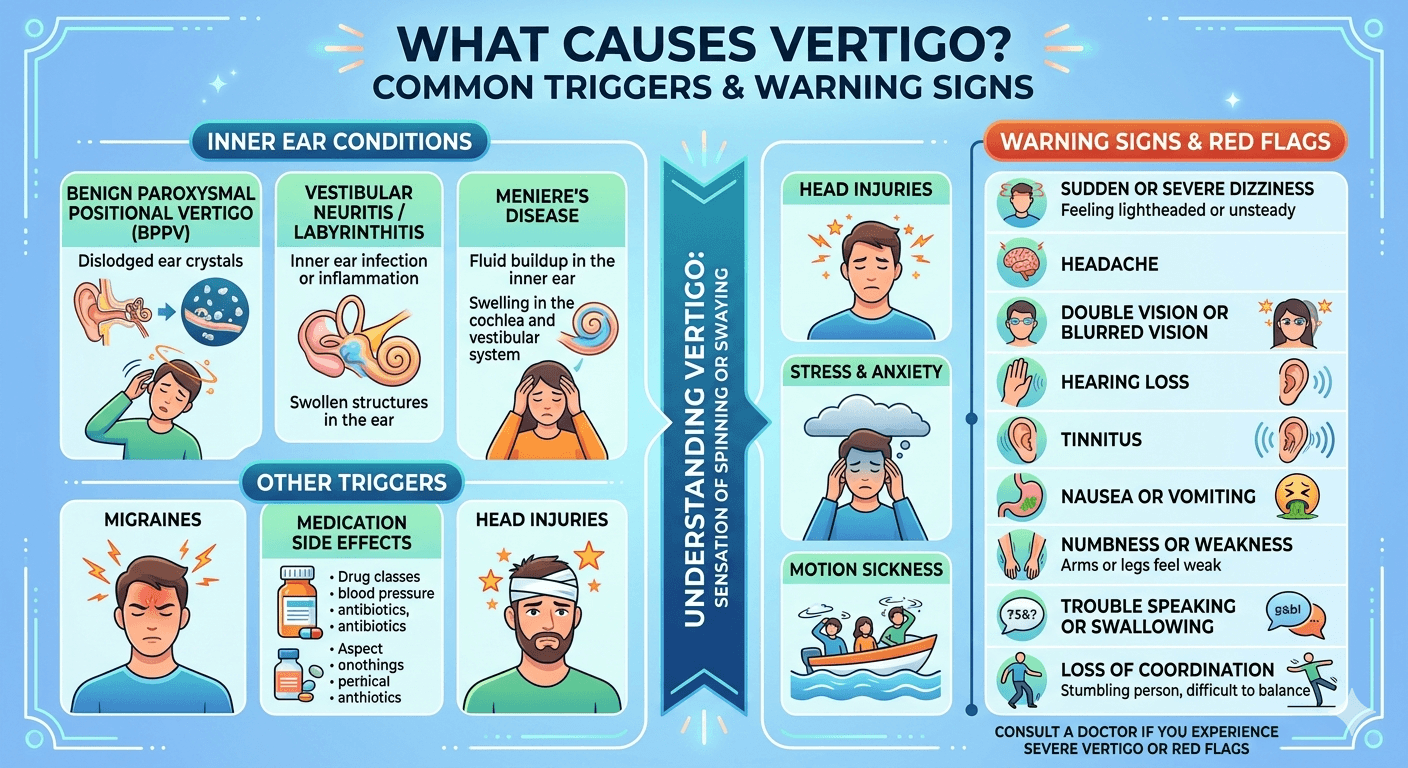
What Causes Vertigo? Common Triggers and Warning Signs
This article reveals the essence of vertigo, its cause, most common triggers, symptoms that never should be ignored.
Introduction
Think about exiting a merry-go-round that spins too fast. Despite standing on the floor, everything feels dizzy and chaotic. However, now imagine yourself feeling that way while walking, working at your desk or even resting in bed. That is precisely what many vertigo sufferers go through.
Learn more about what causes vertigo, its potential triggers, medical disorders leading to vertigo, and red flags that need immediate medical intervention. Understand the role of vertigo in balance control, learn how vertigo is diagnosed and treated.
Vertigo is not a medical condition but rather a symptom of some other condition. It may be alarming, confusing, and interfere with the everyday routine of a sufferer. Being a physician, I saw plenty of patients arriving with concerns about stroke or some severe neurological disease. Vertigo does not always indicate an acute situation; however, it is often a result of an easily treatable condition involving either the inner ear or balance mechanism.
This article reveals the essence of vertigo, its cause, most common triggers, symptoms that never should be ignored, and ways healthcare providers evaluate and treat this condition.
Disclaimer: The information provided in this blog post is for educational and informational purposes only and should not be considered medical advice. It is not intended to replace professional medical consultation, diagnosis, or treatment.
What Is Vertigo?
Vertigo is the false sensation that you or your surroundings are moving when no actual movement is occurring. Most people describe it as a spinning sensation, but it may also feel like:
- Tilting
- Rocking
- Swaying
- Floating
- Being pulled in one direction
Vertigo differs from general dizziness. Dizziness is a broad term that may include lightheadedness, weakness, or feeling faint. Vertigo specifically involves an illusion of movement.
The Balance System: A Brief Overview
To understand vertigo, it helps to know how the body maintains balance.
Three major systems work together:
- The inner ear (vestibular system) detects head movement and position.
- The eyes provide visual information about surroundings.
- The brain and nervous system integrate signals and coordinate responses.
When these systems send conflicting information to the brain, vertigo can occur.
Think of the balance system as a three-legged stool. If one leg becomes unstable, the entire stool wobbles. Similarly, disruption in any component of the balance system can produce vertigo.
How Common Is Vertigo?
Vertigo turns out to be quite common.
Several studies show that a considerable number of people develop vertigo at least once in their lives. With increasing age, vertigo becomes even more common especially in older individuals.
Women suffer from vertigo more often than men because some vestibular diseases and migraines occur in women more frequently than in men.
Major Causes of Vertigo
Healthcare professionals generally divide vertigo into two broad categories:
Peripheral Vertigo
Peripheral vertigo originates from problems in the inner ear or vestibular nerve.
It accounts for the majority of vertigo cases.
Central Vertigo
Central vertigo results from disorders affecting the brain, particularly the brainstem or cerebellum.
Although less common, central causes may be more serious and require urgent evaluation.
Common Causes of Peripheral Vertigo
1. Benign Paroxysmal Positional Vertigo (BPPV)
BPPV is the most common cause of vertigo.
What Happens?
Tiny calcium carbonate crystals called otoconia normally reside in a part of the inner ear called the utricle. Sometimes these crystals become dislodged and migrate into the semicircular canals.
When the head changes position, the misplaced crystals stimulate balance sensors incorrectly, creating the sensation of spinning.
Typical Triggers
- Rolling over in bed
- Looking upward
- Bending down
- Sudden head movements
Symptoms
- Brief episodes of spinning
- Symptoms lasting seconds to minutes
- Nausea
- Loss of balance
Clinical Importance
BPPV is benign but can significantly affect quality of life and increase fall risk, especially in older adults.
2. Vestibular Neuritis
Vestibular neuritis occurs when the vestibular nerve becomes inflamed, often after a viral infection.
Symptoms
- Sudden severe vertigo
- Difficulty walking
- Nausea and vomiting
- Balance problems
Unlike some other conditions, hearing is usually preserved.
Why It Happens
Viruses may damage or inflame the nerve responsible for transmitting balance information from the inner ear to the brain.
3. Labyrinthitis
Labyrinthitis is similar to vestibular neuritis but affects both balance and hearing structures.
Symptoms
- Severe vertigo
- Hearing loss
- Tinnitus (ringing in the ears)
- Nausea
Because hearing changes occur, distinguishing labyrinthitis from vestibular neuritis is important clinically.
4. Ménière’s Disease
Ménière’s disease is a chronic inner ear disorder believed to involve abnormal fluid accumulation.
Classic Symptom Triad
- Episodic vertigo
- Fluctuating hearing loss
- Tinnitus
Many patients also report a feeling of pressure or fullness in the ear.
Duration
Episodes may last from 20 minutes to several hours.
Potential Triggers
- High salt intake
- Stress
- Fatigue
- Caffeine
- Alcohol
5. Vestibular Migraine
Many people are surprised to learn that migraines can cause vertigo.
Characteristics
- Episodes of vertigo lasting minutes to hours
- Sensitivity to light
- Sensitivity to sound
- Headache may or may not be present
Vestibular migraine is increasingly recognized as a common cause of recurrent vertigo.
Common Triggers
- Lack of sleep
- Hormonal changes
- Stress
- Certain foods
- Bright lights
Central Causes of Vertigo
1. Stroke
One of the most important conditions to recognize is stroke involving the brainstem or cerebellum.
Warning Signs
Vertigo accompanied by:
- Double vision
- Slurred speech
- Weakness
- Facial drooping
- Difficulty swallowing
- Severe imbalance
These symptoms require immediate emergency evaluation.
2. Multiple Sclerosis (MS)
Multiple sclerosis can damage pathways involved in balance and coordination.
Associated Symptoms
- Numbness
- Vision changes
- Weakness
- Coordination difficulties
Vertigo may occasionally be one of the earliest manifestations.
3. Brain Tumors
Although uncommon, tumors affecting balance centers can produce vertigo.
Additional Symptoms
- Progressive headaches
- Hearing loss
- Neurological deficits
- Coordination problems
4. Cerebellar Disorders
The cerebellum plays a critical role in maintaining balance.
Diseases affecting this region may cause:
- Persistent vertigo
- Unsteady gait
- Poor coordination
- Difficulty with precise movements
Common Triggers That Can Worsen Vertigo
Even when an underlying condition exists, certain factors may provoke or worsen symptoms.
Head Position Changes
Especially common in BPPV.
Examples include:
- Turning in bed
- Looking upward
- Bending forward
Stress and Anxiety
Stress and Anxiety does not directly cause most vestibular disorders but can intensify symptoms.
Many patients notice that episodes become more frequent during emotionally difficult periods.
Sleep Deprivation
Lack of sleep can worsen:
- Vestibular migraine
- Balance disturbances
- Perceived dizziness severity
Dietary Factors
Certain foods and beverages may trigger attacks in susceptible individuals.
Potential culprits include:
- Excess salt
- Alcohol
- Caffeine
- Processed foods
- Foods containing monosodium glutamate (MSG)
Dehydration
Inadequate hydration may contribute to dizziness and worsen balance problems.
Maintaining adequate fluid intake is especially important during illness or hot weather.
Certain Medications
Several medications can affect balance.
Examples include:
- Sedatives
- Antiseizure medications
- Some antibiotics
- Certain blood pressure medications
Medical students should remember the term ototoxicity, which refers to medication-induced damage to the inner ear.
Recognizing the Warning Signs
Most vertigo is not life-threatening, but some symptoms demand urgent medical attention.
Seek emergency care if vertigo occurs alongside:
Neurological Symptoms
- Facial weakness
- Arm or leg weakness
- Difficulty speaking
- Confusion
- Vision loss
Severe Headache
A sudden, intense headache may indicate a neurological emergency.
Chest Pain
Vertigo combined with chest pain requires immediate assessment.
Persistent Vomiting
Severe dehydration can develop rapidly.
Inability to Walk
Extreme imbalance may signal a serious central nervous system problem.
How Doctors Diagnose Vertigo
Diagnosis begins with a detailed history.
As physicians, we often gain crucial clues from how patients describe their symptoms.
Important questions include:
- When did symptoms begin?
- How long do episodes last?
- What triggers them?
- Are hearing changes present?
- Are there neurological symptoms?
Physical Examination
A comprehensive evaluation may include:
Eye Movement Testing
Abnormal eye movements called nystagmus can help identify the cause.
Balance Assessment
Doctors may evaluate:
- Gait
- Coordination
- Postural stability
Positional Testing
The Dix-Hallpike maneuver is commonly used to diagnose BPPV.
Additional Tests
Depending on findings, physicians may order:
- Hearing tests
- MRI scans
- CT scans
- Blood tests (CBC, Lipid profile, CRP,
- Thyroid profile
- Liver function test
- KFT with Electrolytes
- Vit D
- RBS, HbA1c
- Vestibular function testing
Treatment Approaches
Treatment depends on the underlying cause.
BPPV Treatment
Special repositioning maneuvers, such as the Epley maneuver, often provide rapid relief.
Vestibular Rehabilitation
Physical therapy exercises help the brain adapt to altered balance signals.
These exercises can be remarkably effective for many vestibular disorders.
Medications
Depending on the cause, treatment may include:
- Antiemetics for nausea
- Vestibular suppressants
- Migraine medications
- Steroids in selected cases
Lifestyle Modifications
Patients may benefit from:
- Good sleep hygiene
- Stress management
- Adequate hydration
- Dietary adjustments
- Regular exercise
Frequently Asked Questions (FAQs)
Is vertigo the same as dizziness?
No. Vertigo specifically refers to the sensation of movement or spinning, while dizziness is a broader term that includes lightheadedness and feeling faint.
Can anxiety cause vertigo?
Anxiety can worsen dizziness and may contribute to sensations similar to vertigo, but true vertigo usually has an underlying vestibular or neurological cause.
How long does a vertigo episode last?
It varies. BPPV episodes often last seconds, while Ménière’s disease and vestibular migraine attacks may last hours.
Is vertigo dangerous?
Most cases are not dangerous, but vertigo accompanied by neurological symptoms may indicate a stroke or other serious condition.
Can dehydration trigger vertigo?
Yes. Dehydration can worsen dizziness and may aggravate existing balance disorders.
Does vertigo go away on its own?
Some forms resolve spontaneously, while others require treatment or ongoing management.
Can young people develop vertigo?
Absolutely. Although more common in older adults, vertigo can occur at any age.
When should I see a doctor for vertigo?
Seek medical evaluation if symptoms are severe, recurrent, associated with hearing changes, or accompanied by neurological symptoms.
Conclusion
Vertigo is an indication that stems from an impairment within the complex system of the body that regulates balance. Some of the main causes of vertigo are benign paroxysmal positional vertigo (BPPV), vestibular neuritis, labyrinthitis, Ménière’s disease, and vestibular migraine. In some cases, however, vertigo might be indicative of more serious medical problems like stroke and multiple sclerosis.
Knowing the common causes like changes in head position, stress, lack of sleep, dehydration, and diet will enable patients to control their vertigo more effectively. On the other hand, recognizing those situations where vertigo indicates something more serious and requires immediate professional assistance is also important, for example, weakness, trouble speaking, a very bad headache, or not being able to walk.
For patients, knowledge will turn fear into confidence. For medical students, vertigo provides an interesting example of interaction of different sensory systems for keeping balance.
Read More https://www.ncbi.nlm.nih.gov/books/NBK482356/