
What Is Guillain-Barré Syndrome (GBS)? Symptoms and recovery
Wondering what Guillain-Barré Syndrome (GBS) is? Learn about this rare neurological disorder where the immune system attacks the nerves. Discover key GBS symptoms like weakness and tingling and find insights on treatment and the recovery timeline. Stay informed with expert, location-accurate medical insights near you today.
Introduction
Guillain-Barré Syndrome (GBS) is a rare but serious neurological disorder in which the body’s immune system mistakenly attacks the peripheral nervous system. This condition can develop rapidly and may lead to muscle weakness, paralysis, and, in severe cases, life-threatening complications affecting breathing and heart function.
Wondering what Guillain-Barré Syndrome (GBS) is? Learn about this rare neurological disorder where the immune system attacks the nerves. Discover key GBS symptoms like weakness and tingling and find insights on treatment and the recovery timeline. Stay informed with expert, location-accurate medical insights near you today.
Although Guillain-Barré Syndrome is uncommon, it is considered a neurological emergency because symptoms can worsen within days or weeks. Fortunately, advances in medical care have significantly improved outcomes, and most patients experience substantial recovery over time.
This article provides a comprehensive overview of GBS, including its causes, symptoms, diagnosis, treatment options, recovery process, and long-term outlook.
Understanding Guillain-Barré Syndrome
What Is GBS?
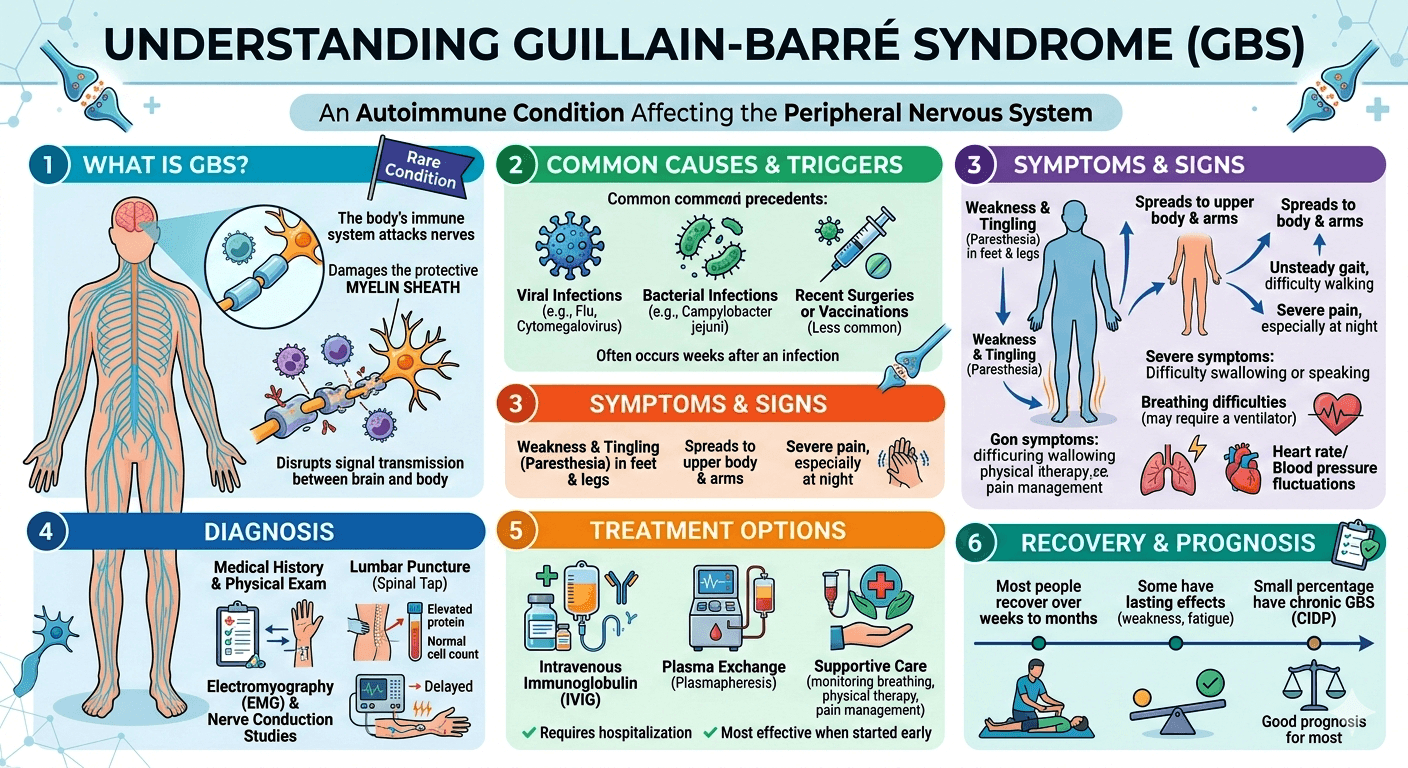
Guillain-Barré Syndrome is an autoimmune condition that affects the peripheral nerves, the network of nerves outside the brain and spinal cord. In GBS, the immune system attacks the protective covering of nerves (myelin sheath) or, in some cases, the nerve fibers themselves.
When nerves become damaged, communication between the brain and muscles is disrupted, resulting in weakness, numbness, and impaired movement.
How Common Is Guillain-Barré Syndrome?
GBS is considered rare.
Key Statistics
| Fact | Details |
| Annual incidence | Approximately 1–2 cases per 100,000 people |
| Age affected | Can occur at any age |
| Gender | Slightly more common in males |
| Risk | Increases with age |
Most people develop GBS only once in their lifetime.
What Causes Guillain-Barré Syndrome?
The exact cause remains unclear. However, GBS often occurs after an infection that triggers an abnormal immune response.
Common Triggers
1. Respiratory Infections
Many patients report having a cold, flu-like illness, or respiratory infection in the weeks preceding symptoms.
2. Gastrointestinal Infections
One of the strongest associations is with:
Campylobacter jejuni
This bacterium commonly causes food poisoning and diarrhea.
3. Viral Infections
GBS has been linked to:
- Influenza
- COVID-19
- Epstein-Barr Virus Infection
- Cytomegalovirus Infection
- Zika Virus Disease
- Hepatitis A, B, C, E
4. Surgery or Trauma
In rare situations, surgery, trauma, or major physical stress may precede the onset of symptoms.
How Does GBS Affect the Nervous System?
Normally, nerves transmit electrical signals efficiently because they are insulated by myelin.
In GBS:
- The immune system attacks myelin or nerve fibers.
- Signal transmission slows or stops.
- Muscles receive incomplete instructions.
- Weakness and paralysis develop.
The condition usually begins in the feet and legs before progressing upward.
This characteristic pattern is called ascending paralysis.
Types of Guillain-Barré Syndrome
GBS includes several subtypes.
Acute Inflammatory Demyelinating Polyneuropathy (AIDP)
This is the most common form in North America and Europe.
Characteristics:
- Myelin damage
- Ascending weakness
- Loss of reflexes
Acute Motor Axonal Neuropathy (AMAN)
Primarily affects motor nerves.
Features:
- Severe weakness
- Less sensory involvement
- Common in some Asian and Latin American populations
Acute Motor-Sensory Axonal Neuropathy (AMSAN)
A more severe axonal form involving both sensory and motor nerves.
Patients often require longer recovery periods.
Miller Fisher Syndrome (MFS)
A rare variant characterized by:
- Eye muscle weakness
- Poor coordination
- Loss of reflexes
Many patients recover well with treatment.
Symptoms of Guillain-Barré Syndrome
Symptoms typically appear days to weeks after an infection.
Early Symptoms
Common warning signs include:
- Tingling in feet and hands
- Numbness
- Muscle weakness
- Leg heaviness
- Difficulty climbing stairs
- Unsteady walking
Many patients initially mistake symptoms for fatigue or a minor neurological issue.
Progressive Symptoms
As the condition advances, symptoms may include:
Muscle Weakness
Weakness generally starts in the legs and moves upward.
Affected areas may include:
- Legs
- Arms
- Hands
- Face
- Neck
Loss of Reflexes
Doctors often find absent or significantly reduced reflexes during examination.
Pain
Many patients experience:
- Back pain
- Leg pain
- Nerve pain
- Muscle aches
Pain can sometimes be severe.
Facial Weakness
Patients may notice:
- Difficulty smiling
- Trouble closing eyes
- Slurred speech
Difficulty Swallowing
Weakness of throat muscles can interfere with swallowing and increase aspiration risk.
Severe Symptoms and Emergency Warning Signs
GBS can become life-threatening.
Seek immediate medical attention if any of the following occur:
Breathing Difficulties
Weak respiratory muscles may prevent adequate breathing.
Approximately one-third of patients require ventilatory support during the acute phase.
Rapidly Progressive Paralysis
Weakness worsening over hours or days requires urgent evaluation.
Autonomic Nervous System Dysfunction
GBS can affect involuntary body functions, causing:
- Blood pressure fluctuations
- Abnormal heart rhythms
- Excessive sweating
- Digestive disturbances
How Is Guillain-Barré Syndrome Diagnosed?
There is no single test that definitively diagnoses GBS.
Diagnosis relies on clinical evaluation and supportive investigations.
Medical History
Doctors assess:
- Recent infections
- Symptom progression
- Pattern of weakness
- Sensory symptoms
Neurological Examination
The examination evaluates:
- Muscle strength
- Reflexes
- Sensation
- Coordination
Loss of reflexes is a hallmark finding.
Lumbar Puncture (Spinal Tap)
Cerebrospinal fluid (CSF) analysis often reveals:
Albuminocytologic Dissociation
This means:
- Elevated protein levels
- Normal or mildly elevated white blood cell counts
This finding strongly supports GBS.
Nerve Conduction Studies
These tests measure how quickly electrical signals travel through nerves.
They help:
- Confirm nerve damage
- Identify subtype
- Assess severity
Electromyography (EMG)
EMG evaluates muscle and nerve function and can provide additional diagnostic information.
Treatment of Guillain-Barré Syndrome
GBS requires hospitalization, especially during the early stages.
Intravenous Immunoglobulin (IVIG)
IVIG is one of the primary treatments.
It works by:
- Modifying immune activity
- Reducing nerve damage
- Accelerating recovery
Treatment is typically administered over several days.
Plasma Exchange (Plasmapheresis)
This procedure removes harmful antibodies from the bloodstream.
Benefits include:
- Faster symptom stabilization
- Reduced severity
- Improved recovery outcomes
IVIG and plasma exchange are generally considered equally effective.
Supportive Care
Supportive management is critical.
Patients may require:
- Intensive care monitoring
- Respiratory support
- Nutritional assistance
- Blood clot prevention
- Pain management
Rehabilitation and Physical Therapy
Recovery often continues long after the acute phase.
Physical Therapy
Goals include:
- Restoring strength
- Improving mobility
- Preventing contractures
- Enhancing balance
Occupational Therapy
Therapists help patients regain:
- Dressing skills
- Bathing abilities
- Hand function
- Daily independence
Speech and Swallow Therapy
Necessary when facial or throat muscles have been affected.
Recovery From Guillain-Barré Syndrome
How Long Does Recovery Take?
Recovery varies considerably.
| Stage | Typical Duration |
| Symptom progression | Days to 4 weeks |
| Plateau phase | Days to weeks |
| Recovery phase | Months to years |
Most improvement occurs during the first year.
Recovery Outcomes
Approximately:
- 70–80% achieve substantial recovery.
- Some retain mild weakness or fatigue.
- A small percentage experience severe long-term disability.
Factors Associated With Better Recovery
These include:
- Early diagnosis
- Prompt treatment
- Younger age
- Less severe nerve damage
- Effective rehabilitation
Potential Long-Term Effects
Even after recovery, some individuals may experience:
Chronic Fatigue
Fatigue is among the most common residual symptoms.
Persistent Numbness
Some nerve damage may heal slowly.
Muscle Weakness
Residual weakness can persist, particularly after severe cases.
Pain
Neuropathic pain may continue in some patients.
Complications of Guillain-Barré Syndrome
Potential complications include:
- Respiratory failure
- Blood clots
- Pneumonia
- Pressure ulcers
- Heart rhythm abnormalities
- Persistent disability
Close monitoring during hospitalization helps reduce these risks.
Can Guillain-Barré Syndrome Be Prevented?
There is currently no guaranteed way to prevent GBS.
However, general measures may reduce infection-related triggers:
- Regular hand hygiene
- Safe food preparation
- Vaccination according to medical guidance
- Prompt treatment of infections
Because the condition is rare, most infections do not lead to GBS.
Frequently Asked Questions (FAQs)
1. Is Guillain-Barré Syndrome contagious?
No. GBS itself is not contagious. However, some infections that trigger it can spread between individuals.
2. Can Guillain-Barré Syndrome cause paralysis?
Yes. Severe cases can result in temporary paralysis affecting the arms, legs, face, and breathing muscles.
3. Is Guillain-Barré Syndrome curable?
There is no instant cure, but many patients recover significantly with proper treatment and rehabilitation.
4. How quickly do symptoms develop?
Symptoms usually progress over days to several weeks, often reaching maximum severity within four weeks.
5. Can Guillain-Barré Syndrome return?
Recurrence is uncommon but possible in a small percentage of patients.
6. Is recovery always complete? Not always. Many patients recover fully, while others may experience lasting fatigue, weakness, or sensory symptoms.
Conclusion
Guillain-Barré Syndrome (GBS) is a rare autoimmune neurological disorder that attacks the peripheral nerves, leading to weakness, numbness, and sometimes paralysis. Although the condition can progress rapidly and become life-threatening, early recognition and prompt treatment with intravenous immunoglobulin or plasma exchange have dramatically improved outcomes.
Most patients recover substantially, especially when diagnosis, treatment, and rehabilitation begin early. Awareness of the warning signs particularly rapidly ascending weakness, loss of reflexes, and breathing difficulties—is essential for timely medical intervention. With comprehensive care and rehabilitation, many individuals affected by GBS can regain independence and return to their normal activities over time.
Disclaimer: The information provided in this blog post is for educational and informational purposes only and should not be considered medical advice. It is not intended to replace professional medical consultation, diagnosis, or treatment. Always seek the guidance of a qualified healthcare professional regarding any medical condition or health-related concerns.